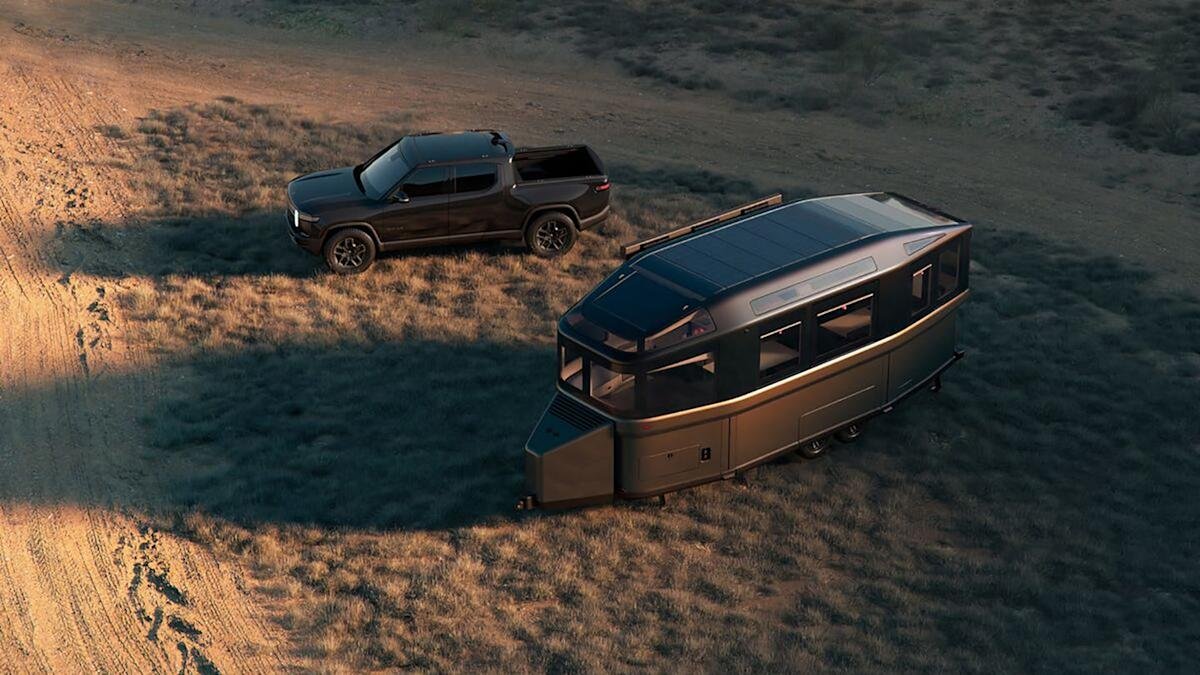

Next year 2026, is slated to be a big one for electric RV startup Lightship. In 2025, it was the year it began production of its flagship trailer, a spaceship-shaped vehicle decked out with solar arrays to enable off-grid adventures. 2026 is ramping up production — no small thing for a product that has thousands of parts and isn’t yet at economies of scale, especially in the gnarled-up world of establishing a supply base from scratch.
“The story of our products and the ownership experience we’re trying to create around them is that it should just be what RVing was always intended to be, which is freedom off-grid in beautiful places and being able to take your comfort with you on the road, wherever you go,” Lightship co-founder and chief product officer Ben Parker told Mid Breaker.
Electric RV Hitting The Road:
Lightship was founded in 2020 by Parker and another Tesla alum, Toby Kraus. “I had a pet project while at Tesla to go electrify all the food trucks in the Bay Area, because I couldn’t stand yelling over a gas generator every day to put in my lunch order,” said Parker. “That snowballed into, let’s build a from-the-ground-up, all electric RV company.”
He and Kraus set about raising money (the start-up announced a $34 million Series B funding round last year) and developing a product, with the decision to handle much of the component design in-house. And 80 percent of Lightship’s components are bought domestically, executives say.
“We made the strategic decision to in-source manufacturing, and I think we were a little bit compelled by our Tesla heritage,” Parker said. “It’s also very, very practically important to us, because when you’re a tiny startup, you have virtually no leverage in your supply base.”
Electric RV Built-in Solar:
Among the features of Lightship’s products that he said make it stand out are solar arrays integrated into the roof. “The panel’s extremely light, so we can actually bond it into the composite roof assembly, which already has perfect impressions in it to accept that solar panel,” he said. “What you have achieved with that is an extremely mass-efficient and, in terms of power generating efficiency, a high-power-efficiency way to build a solar array. And that sort of thinking of being built in, not bolted on, really applies at literally every level of this product.”
“We also swung for the fences and put a big battery in there and a huge solar array on the roof, and if you’re going to take an inch here, enable a product category, make a real dent in an industry frankly, then you might as well go all in,” he added.
The electric RV segment is expanding, with offerings from other startups like Grounded and Evotrex, a hybrid RV trailer company that emerged from stealth earlier this month to announce a $16 million seed round.
“I think it’s a sign this is actually gonna happen,” Parker said of the growing crop of startups in the space.
Electric RV Ramping Production:
For now, Lightship’s challenge is less around demand” (Parker wouldn’t share specific numbers but said the startup has “many hundreds of customers on a waiting list and “many millions of dollars of orders booked”) and more around supply.
“The core issue for an upstart vehicle maker is the ramp from zero production to hundreds and then thousands of vehicles per year as we intend and plan,” Parker said. “We’re still in the early days.”
Lightship commenced the production of its first model, the AE. 1 Cosmos Edition, in August at its Broomfield, Colo., factory, and said it will introduce two more trims: the AE. 1 Atmos and AE. 1 Panos. The base price of the Atmos is $184,000; deliveries are scheduled to begin in spring. Panos begins at $151,000; deliveries are expected to begin later in 2026.
“The demand for the Cosmos Edition confirmed that there is a market eager for electric RVs without compromise on performance or design,” said co-founder and CEO Kraus in a statement. “Now we are opening those doors wider. Atmos and Panos also help bring our vision of sustainable adventure to more families, as well as adventurers who might have a different style of camping.”
The wagons are powered by Lightship’s own TrekDrive system, which the company calls “an intelligent propulsion technology that can double the range or mpg of the tow vehicle.”
Product development and manufacturing “often happen simultaneously” at this stage in the startup’s life, said Hayley Cashdollar, head of operations at Lightship, in an email to Mid Breaker.
It may sound difficult, Amstadter said, but that process has actually turned up some amazing synergies where designing helps manufacturing faster or better (and vice versa), can save time and money along the way.
Lightship has built a “handful” of production vehicles it’s delivering to customers so far, Parker added. Next year, the company plans to ramp up production 10 times, to roughly 100 vehicles.
“What are the top hurdles for our company in the upcoming year? They are getting production up and running, which is an economy of scale they didn’t have three years ago, and then they’re taking the cost out of the product,” Parker said. Getting the costs down, and the volumes up has been, he said, “what keeps my co-founder and me up at night.”