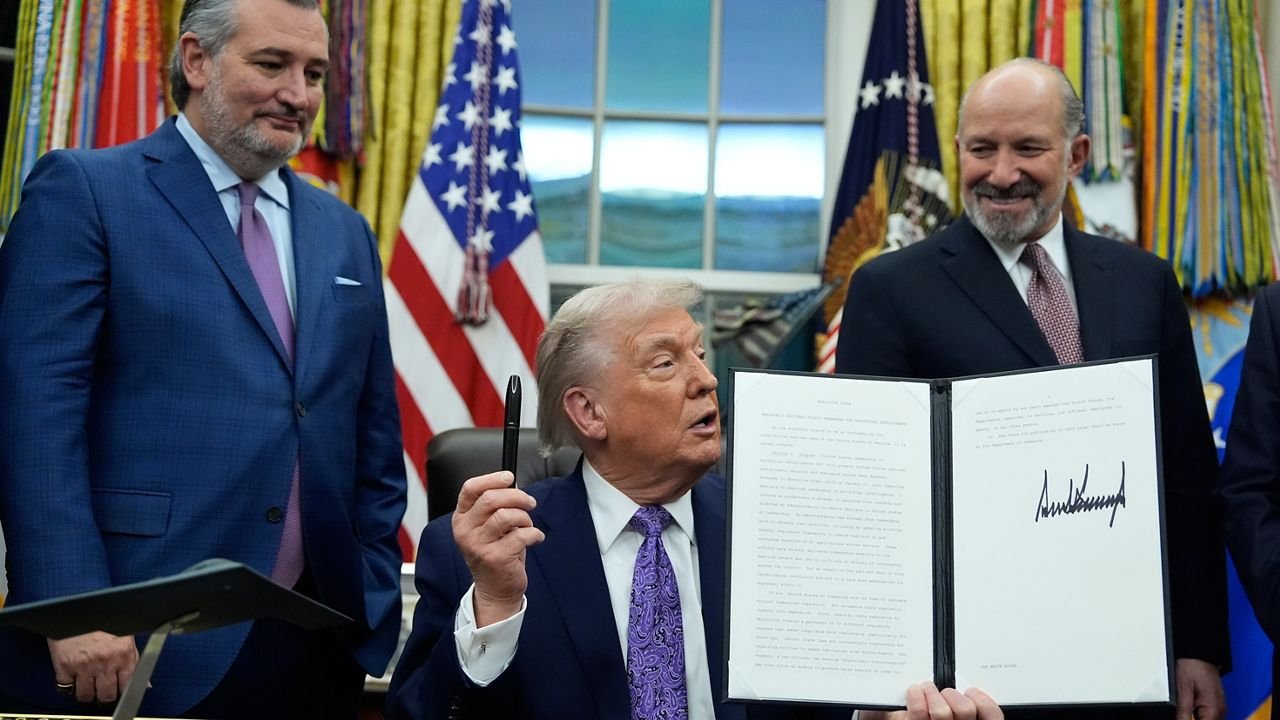

President Donald Trump signed an executive order Thursday evening that directs federal agencies to begin implementing state AI laws, contending that startups need relief from a “patchwork” of rules. Legal experts and startups, meanwhile, say the executive order could extend uncertainty, leading to court battles that, at least in the short term, will have young companies steering through constantly changing state requirements. At the same time, they wait to see whether Congress can forge a single national framework.
The executive order, called “Ensuring a National Policy to Address the Use of Artificial Intelligence in Our Economy and Society,” instructs the Department of Justice to establish a task force within 30 days that will challenge some state laws under the argument that AI is interstate commerce and should be federally regulated. It would give the Commerce Department 90 days to compile a list of “onerous” state AI laws, a review that could affect states’ eligibility for federal funds, such as those used for broadband grants.
It also asks the Federal Trade Commission and the Federal Communications Commission to examine whether federal standards can override state measures, and directs the administration to consult Congress on a single AI law.
The executive order comes as part of a broader effort to clamp down on state-by-state AI regulations after an attempt in Congress to temporarily halt those regulations failed. Both Republican and Democratic lawmakers have said that, without a federal standard, prohibiting states from moving forward can leave consumers vulnerable and companies relatively unchecked.
“This David Sacks-led executive order is a sweetheart deal for Silicon Valley Oligarchs who have been cashing in their chips of influence on Washington to avoid accountability both personally and for their companies,” Michael Kleinman, Head of U.S. Policy at the Future of Life Institute, which works to minimize extreme risks from transformative technologies, said in a statement.
An outspoken voice behind the administration’s AI preemption push, Sacks is Trump’s AI and crypto policy czar.
Even proponents of a national framework admit that the executive order does not establish one. And because state laws are still technically in effect until courts enjoin them or states cease enforcing them, startups might find themselves facing an uncertain transition.
States will go to court seeking protection of their consumer protection authority, and cases could end up at the Supreme Court, LexisNexis North America, U.K., and Ireland CEO Sean Fitzpatrick told TechCrunch.
Supporters argue the executive order could help reduce uncertainty by effectively centralizing the fight over AI regulation in Washington; critics say that legal battles will immediately create headwinds for startups seeking to navigate competing state and federal demands.
“Startups are focused on innovation, and startups don’t have until they reach a scale … robust regulatory governance in place, which is why we provide for that.” Hart Brown, one of the primary authors of Oklahoma Governor Kevin Stitt’s Task Force on AI and Emerging Technology recommendations, says. “These programs may be expensive and burdensome to satisfy a rapidly evolving regulatory environment.”
Co-founder of Circuit Breaker Labs, Arul Nigam, added that he shared those apprehensions.
“There’s a lack of clarity as to whether [AI companion and chatbot companies] have to self-regulate?” Nigam said in an interview with TechCrunch, adding that the disjointed state of AI legislation is hurting smaller startups in his space. “Do they have open-source standards that they should be following? Should they continue building?”
He went on to say that he is optimistic that, thanks to this incident, Congress can act more expeditiously and pass a stronger federal framework.
Trustible, an AI governance startup, CoreDNS CTO and co-founder Andrew Gamino-Cheong, the EO will actually work against AI innovation and pro-AI goals: “Big Tech and the big AI startups have either the resources to fork out for legal help on how they can make sense of all these regulations, or can just go fence sit.” ”The uncertainty does hurt small startups, especially those that can’t get hold of several billion dollars almost at will,” he added.
Combined with the legal gray area, which makes its business more appealing to risk-averse customers such as legal teams, financial firms, and health care organizations, this creates more difficulty, stretches sales cycles and systems, and even increases insurance costs. “Just the perception that AI is unregulated will undermine trust in AI,” which Gamino-Cheong said is already poor and poses a threat to adoption.
Businesses would appreciate a single national standard, said Gary Kibel, a partner at Davis + Gilbert, but “an executive order is not necessarily the right vehicle to override laws that states have duly enacted.” The current uncertainty, he cautioned, could yield two extremes: either highly restrictive rules or business as usual — either of which would be a “Wild West” that serves the interests of Big Tech’s ability to absorb risk and wait it out.
Meanwhile, the App Association president, Morgan Reed, called on Congress to swiftly pass a national AI framework that is “comprehensive, targeted, and risk-based.” We can’t have a patchwork of state AI laws, and a multi-year court battle over the constitutionality of an Executive Order is no better.” Source